Forecast Library is now live. Future Edge Group is launching a public archive that gives forecasts a stable reference, an inspectable history and a downloadable receipt. As of September 19, 2026, the catalog contains 4,511 receipts across 376 forecast subjects, including 60 verified blockchain proofs.
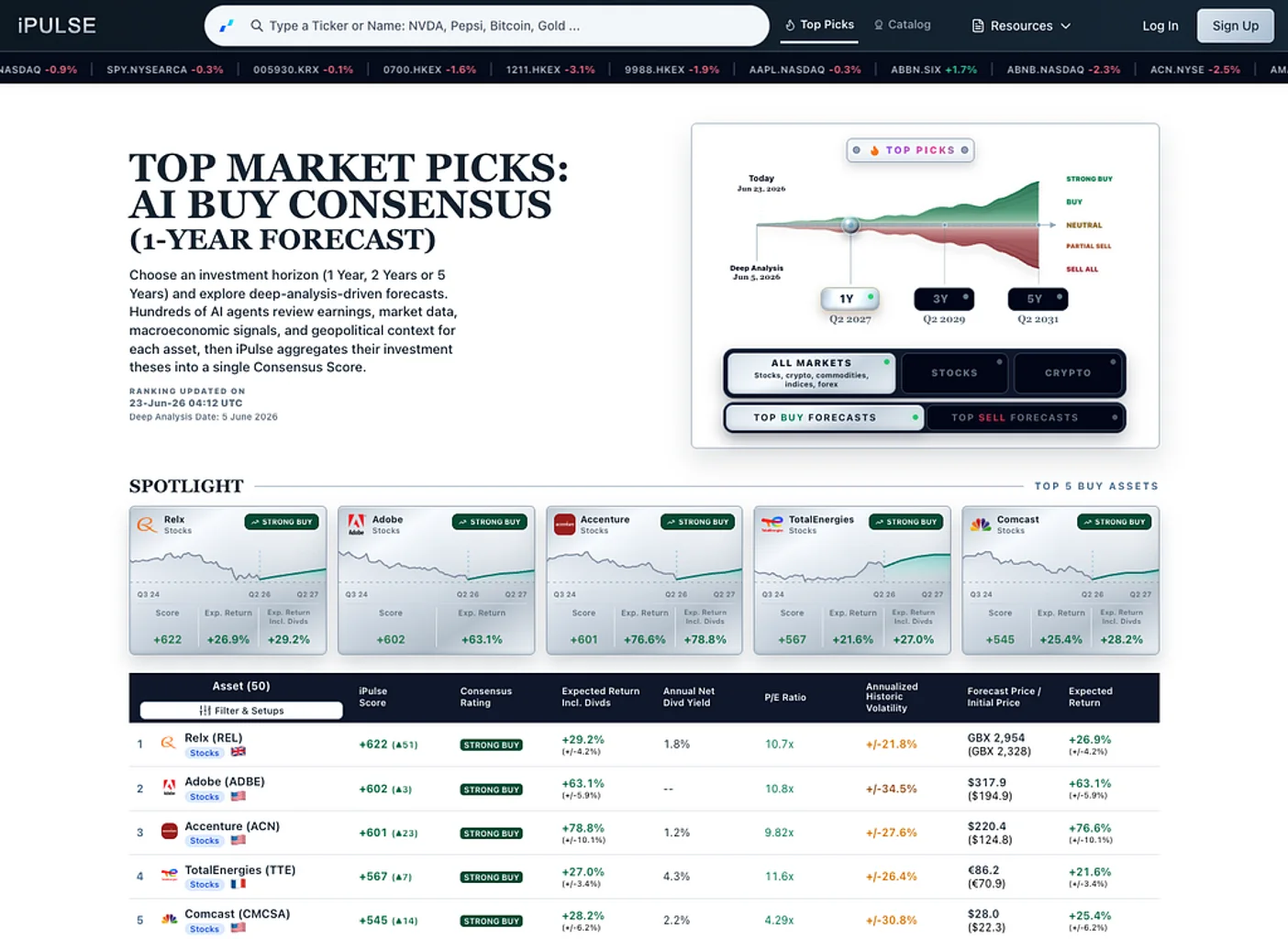
iPulse AI, our Open Agentic Investment Research Platform, is the Library’s first live publisher. The platform helps readers examine current market research; the Library preserves the individual forecast records that should remain available after the market, the model or the publisher changes its mind.
You can browse without an account, inspect declared provenance, download a structured receipt and follow its proof links. Start with the PepsiCo example, or read on for the problem the Library addresses and the limits of what its proofs establish.
Why forecasts need a public memory
Imagine an AI research system issues a cautious forecast at 8:59.
At 9:07, a company files new results. At 9:12, the system becomes optimistic. By lunchtime, the earlier warning has disappeared and the latest answer looks inevitable.
Did the system learn something? Or did the interface quietly lose the evidence of what it used to believe?
You cannot answer that question by looking at the latest dashboard. You need the earlier forecast, the information behind it, and a record of what changed.
The Library exists to make a prediction easier to challenge. Especially when the prediction is ours.
The forecast you can no longer find
AI makes it cheap to produce another answer. Keeping an honest history takes a different kind of discipline.
A new model arrives. A prompt improves. A data provider corrects a field. Each change can make the current product better while making its past harder to reconstruct. Run the same question today and you may get a perfectly reasonable answer to a subtly different question.
That matters to anyone evaluating research. A persuasive explanation after the event is not evidence of foresight before it. Nor does a revised forecast tell you whether the original mistake came from missing information, faulty reasoning, or a risk that could not have been anticipated.
I want to be able to ask both: what is the best current view, and which historical decision are we evaluating? Those questions need separate records.
For context, I founded Future Edge Group, which operates the Library and builds iPulse AI, our Open Agentic Investment Research Platform. iPulse AI is the Library’s first live publisher. The two serve different jobs: iPulse AI helps investors inspect current market research; the Library preserves individual forecast records that readers can return to later.
One date cannot tell the whole story
Consider a security camera. It records an event at 10:03. The footage uploads at 10:11. An investigator collects it at 11:20. The evidence is sealed at 12:05.
Replacing those times with a single field called “date” would destroy useful information. AI research has the same problem.
The base model has a training knowledge boundary. The supplied company data has its own reporting period. A market price was observed at a particular time. A search tool may or may not have retrieved fresh evidence during the run. The forecast was generated, published and eventually evaluated at different moments.
A fresh search does not update everything the model knows. A configured search tool does not prove the tool ran. And a forecast created in July can still rely partly on information from May.
Forecast vintage and forecast horizon must also stay separate. The vintage describes when the prediction was made and its information context. The horizon describes how far into the future it reaches. A five-year forecast does not become a completed five-year performance result because someone has published its receipt.

Figure 1. An AI decision does not have one as-of date. Its temporal provenance spans model memory, later adaptation, real-world events, retrieved evidence, computation, release and eventual evaluation.
Source: iPulse AI
Open a receipt and look for the gaps
Here is a concrete example: a PepsiCo forecast receipt from the Ray Dalio-inspired AI forecaster in iPulse AI. The persona is an AI analytical framework, with no affiliation or endorsement by Ray Dalio.
The record states that the forecast was generated on July 5, 2026, at 14:48 UTC. It preserves a 20-step path with three months between steps. Its declared model knowledge cutoff is January 31, 2025; the latest dated information in its supplied input context is May 31, 2026.
More revealing are the gaps. The input context is labelled a reconstructed backfill. Search was configured, but search execution is unknown. The evidence manifest was not captured. Review of this particular forecast is not recorded.
That is the useful discomfort of a public record. Readers can see where the evidence ends. A blank field cannot silently become a claim that the system consulted the right sources.
The current collection begins with iPulse AI’s Batch 6 historical publication. It is not a complete archive of every forecast we have ever generated. The 60 blockchain proofs cover all 12 original advisor forecasts for each of five showcase assets: PepsiCo, NVIDIA, Alphabet, Bitcoin and SPY. They are not 60 selected winning calls, and the proof count is not an accuracy score.
A reader can browse without an account, inspect an individual forecast, download its structured JSON receipt and follow its proof links. Developers can work with the open format rather than scraping a dashboard.
Why add blockchain to a perfectly good archive?
A fair objection is that databases already store history. Versioned files and disciplined audit logs can solve much of this problem. Why add another system?
Because a record hosted only by its publisher still asks outsiders to trust that publisher’s account of the record. An external anchor gives them another place to check.
The mechanism is less mysterious than the word “blockchain” suggests:
- Seal the forecast. Put the receipt payload into a consistent JSON representation and compute its SHA-256 digest: a digital fingerprint of that exact payload.
- Anchor the fingerprint. Use Ethereum Attestation Service, or EAS, to record the digest and a compact forecast projection on Base. The full public receipt remains available from the Library; private source material is not uploaded as part of this proof.
- Compare the records. Recompute the downloaded payload’s fingerprint and compare it with the anchored value. Inspect the issuing address, network, transaction and blockchain time separately.
For the current showcase, each asset’s 12 forecasts were submitted together in one transaction. Each forecast still has its own attestation identifier. Batching the transaction does not turn twelve predictions into one consensus forecast.
The receipt’s integrity test makes this tangible. Change one return in the browser demonstration and the result switches from PASS to FAIL. You have changed the fingerprint. The demonstration does not alter the published forecast or write anything to the blockchain.
The illustrated proof guide walks through the external records. You do not need a wallet to inspect them.

Figure 2. A consequential AI forecast should be handled like evidence: identify it, preserve its inputs and versions, seal the decision state, and record every later revision.
Source: iPulse AI
The September timestamp cannot prove a July prediction
This is the boundary that matters most.
The PepsiCo example carries a July 5 forecast-generation date. Its verified Base mainnet anchor is September 12, 2026, at 10:54:39 UTC. The receipt explicitly calls itself retrospective.
The blockchain evidence supports existence of the committed record by that September anchoring time. It does not independently establish that the forecast was sealed in July. Putting an earlier date inside a payload does not make the blockchain witness that earlier date.
It also does not prove that the forecast was accurate, that its reasoning was sound, that the claimed source evidence was complete, or that the named forecaster authored it. An attesting wallet is an identifiable blockchain address; connecting it to a real-world identity requires additional evidence.
Even timely anchoring would leave another problem: selective publication. Someone could preserve thousands of incompatible forecasts and later advertise only the winners. A sound evaluation needs a defined population and disclosure of exclusions, alongside the original records.
Blockchain therefore addresses a narrow but valuable question: does this payload match an independently anchored commitment, and by what time was that commitment recorded? Forecast quality needs a separate test.
Preserve the mistake without publishing everything
An archive becomes useful when it allows a better investigation of failure.
Was important evidence available but missed? Was it retrieved and misunderstood? Did the forecast express more confidence than the evidence justified? Did a market anchor go stale while the run waited in a queue? Or did an unexpected event change the world after the forecast was made?
Those are different failures. They should not all trigger the same response. One might require a better retrieval policy, another a freshness limit, another a different evaluation method. Not every lesson belongs in the model’s weights.
Preserving forecasts makes those investigations possible; it does not demonstrate that learning has already improved performance. That requires subsequent evaluation.
Nor does openness require disclosing licensed datasets, protected prompts, credentials or private infrastructure. The public record can preserve processed outputs, declared provenance, version references and known limitations while clearly identifying what was withheld or never captured.

Figure 3. Selective transparency can preserve methodology, lineage, metrics and integrity without exposing raw prompts, licensed payloads or protected infrastructure.
Source: iPulse AI
The word “declared” matters. A receipt is not a recording of every internal thought, and a valid digest cannot repair incomplete provenance. Corrections should create linked revisions that leave the earlier payload inspectable.
There is a practical limit, too. A blockchain digest cannot reconstruct a missing file. Keeping receipts downloadable, retaining independent copies and maintaining the open verifier remain necessary. An anchor is an additional check, not a replacement for archival care.
A library should be useful beyond its first publisher
The ambition extends beyond AI market forecasts. People, statistical models and AI systems all make claims about the future that deserve a stable reference.
But the implementation has a specific starting point: the live receipt profile covers financial forecasts, and iPulse AI supplies the current production collection. Human and statistical submissions are welcome for manual review; other domains need suitable, reviewed receipt profiles. Automated agent integrations and broader evaluation workflows remain directions for development.
The underlying Open Forecast Receipt project publishes the schema, examples, verifier and implementation. The ambition is for a record to remain inspectable outside the interface that first displayed it.
For researchers, that creates a citable object. For publishers, it creates a history that can be questioned. For investors, it offers a way to examine what a research system actually preserved before accepting its account of its own performance.
The Library will earn its usefulness through consistent coverage, honest corrections and meaningful evaluation as forecasts mature. More receipts alone will not establish better forecasting.
Ask for the receipt
Before trusting an AI forecast, I would ask five questions:
- Can I retrieve the exact earlier forecast?
- Can I distinguish its creation date, information boundaries and forecast horizon?
- Can I see missing evidence, revisions and changes of method?
- Can I verify the preserved payload — and understand the limits of its timestamp?
- Am I looking at a complete, defined cohort with mature outcomes, or selected examples?
Return to the 8:59 warning and the 9:12 reversal. If both decisions survive and the new evidence is traceable, we can investigate what changed. If only the latest answer remains, we cannot.
Start with the PepsiCo receipt above. Read the missing-evidence fields. Compare July’s forecast date with September’s anchor. Try changing one number.
That is the standard I want our own research to face. A forecast worth discussing should remain available when the discussion becomes uncomfortable.
Disclosure: I am the founder of Future Edge Group, the operator of Forecast Library and company behind iPulse AI. This article describes research infrastructure, not investment advice. Forecasts and proof badges do not establish investment merit or guarantee outcomes. Catalog counts and the example receipt were checked on September 19, 2026.
Explore the launch
Browse Forecast Library, inspect the proof guide, or explore iPulse AI. Developers and prospective publishers can start with the Open Forecast Receipt specification and verifier.
The launch is an invitation to inspect the evidence, including its gaps. A preserved forecast is the beginning of accountability; evaluating it honestly is the work that follows.