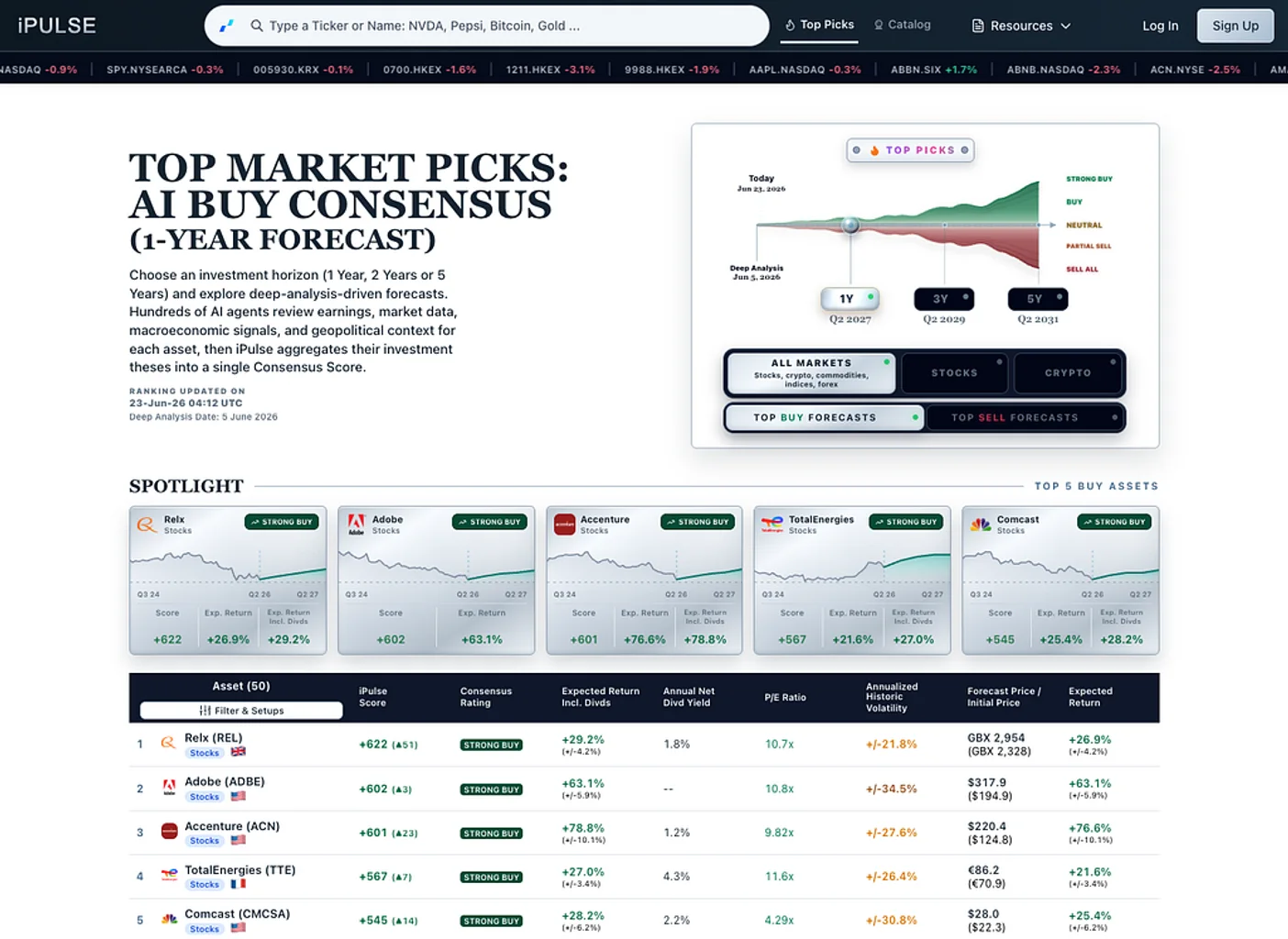
The first ranking implementation recorded in our public lessons ledger dates to 27 March 2026. It came after Batch 2, and older batches were scored retrospectively. That creates a question a latest-only dashboard cannot answer: are you reading what the system originally forecast, or what a later formula says about that forecast?
My answer is to preserve both records and explain their relationship. A forecast describes a possible future from a dated starting point. A ranking is a later calculation over forecasts, prices and a scoring policy. Replacing one with the other would make the product look simpler while making its history harder to investigate.
I am the founder of iPulse AI. This account uses our published build lessons and methodology, reviewed on 15 October 2026. It describes the design consequence of those records, not a newly measured improvement in forecast accuracy.
The decision hidden inside a refreshed ranking
Our frozen-forecast lesson records that a modern scoring formula can be applied to an older research batch. That is legitimate as a retrospective calculation. It becomes misleading if the display implies the newer formula produced the original research.
Three things need separate identities. The first is the prediction: its evidence boundary, anchor, horizon and path. The second is the calculation: which forecasts were eligible, which prices entered, and which formula ran. The third is the publication: what was released and whether an editorial correction changed the visible explanation.
Those records can refer to one another without becoming interchangeable. A better formula should create a traceable calculation. A corrected source should create an explicit revision. Neither should silently turn yesterday's forecast into a prediction made with today's knowledge.
| Record | What it preserves | What a later change does not establish |
|---|---|---|
| Original forecast | Dated anchor, research context, horizon and projected path | That later evidence was known at generation |
| Ranking snapshot | Eligible cohort, price basis, formula and scoring run | That a changed rank means new company research |
| Published edition | Visible explanation, sources and correction history | That an editorial update reran the model |
This is why our engine history distinguishes engine releases, execution batches and ranking versions. These labels are useful only if they let someone reconstruct what changed. Adding several version numbers to a page without explaining their jobs would merely replace one ambiguity with another.
One unchanged endpoint, two different return readings
Here is a deliberately hypothetical example. A forecast begins at 100 and ends at 120. Its original cumulative price scenario is 20%. Later, the market reference used for a remaining-return calculation becomes 110. The return from that reference to the same endpoint is about 9.09%.
Nothing in this example changed the forecast endpoint. Nothing establishes that the forecast became more accurate. The calculation answered a different question.
| Hypothetical reading | Calculation | Result |
|---|---|---|
| Original scenario from its anchor | 120 / 100 - 1 | 20.00% |
| Remaining scenario from a later reference | 120 / 110 - 1 | 9.09% |
| Change in the forecast endpoint | 120 - 120 | 0 |
The example isolates the price-reference change. Real rankings also depend on the formula, covered population, return basis and other inputs. A changed position cannot be attributed to one cause without inspecting those records.
This distinction makes old research more useful. I can ask what the original forecast implied, what today's calculation implies under a stated reference, and whether later observations support either. I do not have to let a refreshed percentage overwrite the original proposition.
Our CAGR and total-return explanation handles the separate arithmetic question. Converting units does not solve the history problem: two perfectly calculated percentages can describe different editions or reference points.
What changed in our operating record
The public ledger describes separate identifiers for engine, batch, formula architecture, scoring-run implementation and recomputation date. Its recorded first observation for this versioning lesson is 27 March 2026, with validation dated 4 September. These are the ledger's dates; they do not claim that every present feature existed at the first implementation.
The history lesson adds another consequence: configuration changes and mistakes belong beside retained forecasts. A history containing only successful-looking results would answer a marketing question, rather than an evaluation question.
For me, the useful unit of progress is therefore a documented change. Which assumption failed? Which part of the calculation changed? What stayed frozen? What evidence would test the new approach? A newer engine number cannot answer those questions by itself.
There is a cost to that choice. Multiple records need clear names, durable links and consistent dates. Readers can encounter an older forecast beside a newer calculation and reasonably ask why they differ. Hiding the earlier edition would remove that discomfort, but also remove the evidence needed to resolve it.
The data-provenance methodology explains the wider source and configuration boundary. Public inspectability does not require distributing licensed inputs, protected prompts or production infrastructure. It does require being clear about what was preserved, what is exposed and what remains unavailable.
A change log should name the changed object
When reviewing a new result, I would first locate its object: forecast, ranking or editorial edition. Then I would compare it with the previous object of the same kind.
If a ranking changed while the forecast stayed fixed, examine price inputs, eligibility and formula version. If the research changed, examine the new evidence and the new generation record. If only the prose was corrected, examine the correction and its sources. These are different investigations.
A useful record should also allow an uncomfortable result to survive. The original forecast might be wrong. A new ranking policy might be worse. A source correction might weaken a claim we previously emphasized. Preserving that possibility is part of making the process inspectable; it is not proof that the process already works better.
For a concrete public example of why preservation matters, our Forecast Library introduction distinguishes a forecast's declared generation date from the later time its payload was externally anchored. A valid integrity check cannot move an external timestamp backward. The same principle applies here: a later calculation cannot rewrite what existed earlier.
What structured intelligence means in this account
I want iPulse AI to make changes explainable, including changes that are inconvenient for the product. That is more specific than promising another confident answer to market noise.
The documented build lesson is that prediction, calculation and publication must remain distinguishable. The hypothetical arithmetic shows one reason their visible outputs can change differently. Neither establishes investment performance, an optimal scoring policy or a guarantee that every historical record is complete.
Start with the engine history, identify one version change, and follow it to its evidence and limitation. The useful outcome is being able to say what changed without pretending that the original system knew it all along.
Sources and scope
First-party sources reviewed 15 October 2026: the public Lessons Learned entries on frozen forecasts, separate version labels and open history; Engine History; and Data Provenance. The numerical example is hypothetical and independently calculated. This expansion draws on later build records; the original 24 June publication and the 15 October analysis cutoff remain separate dates. It is product and research-methodology commentary, not personalized investment advice.