

Executive Abstract
AI adoption can accelerate individual tasks while creating organizational dependencies that remain invisible to leadership. When those gains are absorbed into staffing plans, service commitments and budgets, the ability to recover manually may erode even as productivity dashboards improve. This whitepaper distinguishes decentralized adoption from deliberate transformation of the operating model. It proposes three complementary resilience disciplines: availability of essential services, effective oversight of outputs and actions, and portability of critical workflows across platforms. A criticality-based approach directs stronger controls toward consequential services while allowing low-risk experimentation to continue. Two controlled exercises - a Blackout Drill and a Trojan Horse Drill - test whether teams can sustain essential work and detect plausible errors before they cause downstream harm. Drawing on selected literature and practitioner experience, the paper offers a conceptual framework and practical rehearsal method, not an empirically validated maturity model. The appended one-page scorecard records evidence, exposes failed controls and assigns corrective actions. The central recommendation is to prove recovery and intervention capacity before treating AI-enabled productivity as a permanent operating assumption.
Most people only use AI for basic tasks like drafting emails or summarizing PDFs, completely missing where the real operational seismic shift is happening. Over the course of my career, I have worked on more than 60 projects, including some of the largest enterprise transformation programs in the world. More recently, I built my own AI-native startup from the ground up, where automated agentic workflows now perform a volume of work that I estimate would otherwise require a company of around 800 people.
Seeing both sides of this divide—the sprawling enterprise and the hyper-lean agentic startup—has made one uncomfortable truth impossible to ignore. Imagine your team uses AI to compress a full day’s work into a single hour. Reports land on desks days ahead of schedule, the backlog evaporates, and your department absorbs double the workload without adding a single new hire. Management celebrates the efficiency, locks those productivity gains into next quarter's budget, and quietly closes open job requisitions.
Then, at 9:00 AM on a Tuesday, the AI platform stops responding. The workload is still sitting there. The client deadlines haven't moved. Here is the question that should keep every executive and manager awake tonight: Could your team actually go back to working the way it did six months ago, or has your business already made promises its human beings can no longer keep on their own?
Even more unsettling: what if the AI doesn't go offline, what if you bought a backup subscription to a rival model thinking you were safe, and what if the real catastrophe is happening while every dashboard is glowing green? Before we unpack why that backup subscription won't save you—and how you can test your own team’s survival rate in a single afternoon—we need to name the silent fracture splitting modern organizations apart.
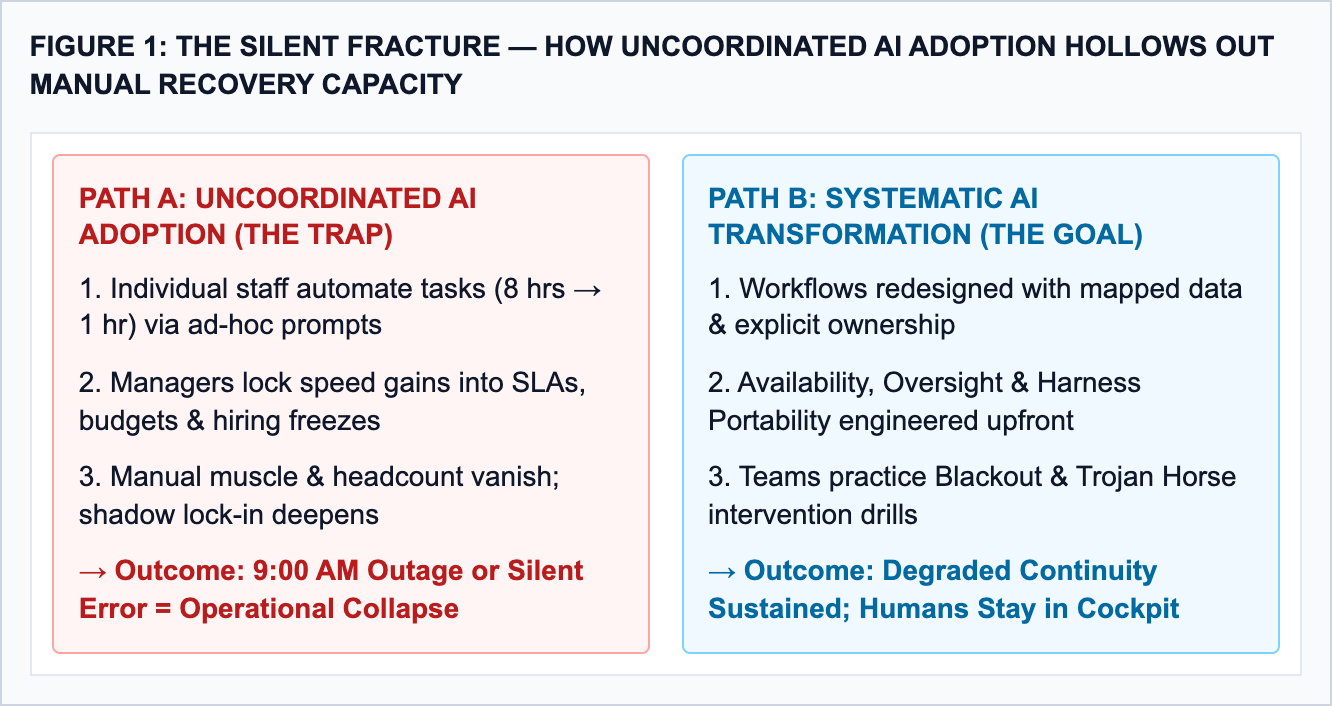
FIGURE 1: THE SILENT FRACTURE — HOW UNCOORDINATED AI ADOPTION HOLLOWS OUT MANUAL RECOVERY CAPACITY
Source: Russlan Ramdowar / Future Edge Group · As of 2026-11-04
1. The Great Illusion: AI Adoption Is Not AI Transformation
Right now, boards and executives across the globe are congratulating themselves on their rapid move into artificial intelligence, particularly as agentic AI systems capable of executing multi-step workflows take center stage [1]. Yet in nearly every boardroom I advise or observe, leaders are confusing two fundamentally different phenomena: AI Adoption and AI Transformation.
| Dimension | AI Adoption (Decentralized & Bottom-Up) | AI Transformation (Systematic & Architectural) |
|---|---|---|
| Core Definition | AI Adoption is decentralized, bottom-up, and spontaneous. Individual employees adopt tools like ChatGPT, Claude, or Microsoft Copilot to accelerate their personal tasks. | AI Transformation is systematic, architectural, and deliberate. Instead of merely handing out logins and cheering from the sidelines, transformation intentionally redesigns the work around the technology. |
| How It Spreads in Practice | An ambitious analyst discovers a clever way to automate a grueling report. A colleague copies the prompt for another workflow. Within weeks, work that used to take two weeks is clearing in two hours. | It maps the underlying data, redefines human accountability, builds verification checkpoints, and establishes concrete business continuity plans for the day the automation fails. |
| Governance & Visibility | Nobody waited for a steering committee, a central strategy, or IT approval—which is precisely why adoption feels like magic, but leaves leadership blind to systemic exposure. | Business owners remain accountable for operational outcomes while engineering and risk teams maintain visibility into dependencies, permissions, and fallback capacity. |
In the beginning, decentralized adoption belongs entirely to the employees using the tools. They remember how they used to do the job manually, they know which weird edge cases the prompt struggles with, and they know where to double-check the math. Then success sets a trap. A manager notices the team has extra bandwidth and promises faster turnaround times to clients. Another department starts routing heavier volumes of requests their way. When a team member resigns, leadership decides not to backfill the role because the remaining staff appears to be handling the load effortlessly. The old manual standard operating procedure might still sit in a shared folder somewhere, but the headcount, time, and institutional memory required to execute it have quietly vanished.
None of these individual decisions looks reckless in isolation. Together, they turn a helpful digital assistant into unmapped, load-bearing infrastructure. The employee still talks about AI as a neat productivity tool, while the organization is already betting its operational survival on it. Will your employees build invisible "shadow dependencies" through bottom-up adoption faster than your leadership can put the organization on a robust transformation journey—and when the bill comes due, will your company even have the budget to fix it?
TAKEAWAY FOR YOUR NEXT TEAM MEETING
AI Adoption is when employees use AI to do their jobs faster. AI Transformation is when the organization redesigns its operations so those speed gains don’t destroy the business when the tool breaks. If you have high adoption and zero transformation, you aren't agile—you're flying blind.
Reflection Question: Look at the fastest-moving team in your department today. If their primary AI tool vanished for 72 hours starting tomorrow morning, what specific deliverables would miss their deadlines, and does their manager actually know the answer?
2. The Google Maps Paradox—and Why Nobody Holds the Whole Map Anymore
To see how quickly human beings surrender vital capabilities to a superior technology, think back to how we all adopted GPS and Google Maps. Nobody needed a "Global Navigation Transformation Program" or a change-management consultant to start using Google Maps. We adopted it individually because it was vastly superior to unfolding paper maps across a steering wheel.
But something subtle happened inside our brains as we followed the glowing blue line. We stopped memorizing street grids and landmarks. A 2020 study examined the GPS habits and spatial memory of 50 regular drivers, following up with 13 of them three years later, and found that heavier GPS reliance was measurably associated with a decline in spatial memory during self-guided navigation [2]. While a small navigation study doesn't prove every professional skill will atrophy under AI, the operational parallel is impossible to miss.
When you outsource the route, you stop learning the terrain. And modern highway driving is designed around the assumption that you already know where your exit is; you cannot simply slam on the brakes in the middle of a six-lane expressway to unfold a paper atlas when your phone battery dies. Inside a modern corporation, the danger is even worse because the map itself gets shattered across multiple people:
Employee A knows the intricate prompt and context window tricks that generate the analysis.
Employee B owns the automated spreadsheet macro that ingests the AI’s output.
Employee C packages that spreadsheet into the final decision sent to a regulator or customer.
Each person understands their two-inch square of the assembly line, while not a single human being in the building can explain—or manually reproduce—the complete route from raw data to final decision. Yet an outage that knocks your AI offline is actually the easiest problem to spot, because when the screen goes blank, everyone knows something is wrong. What happens when the screen stays lit, the workflows keep humming at record speed, and the business drives straight off a cliff?
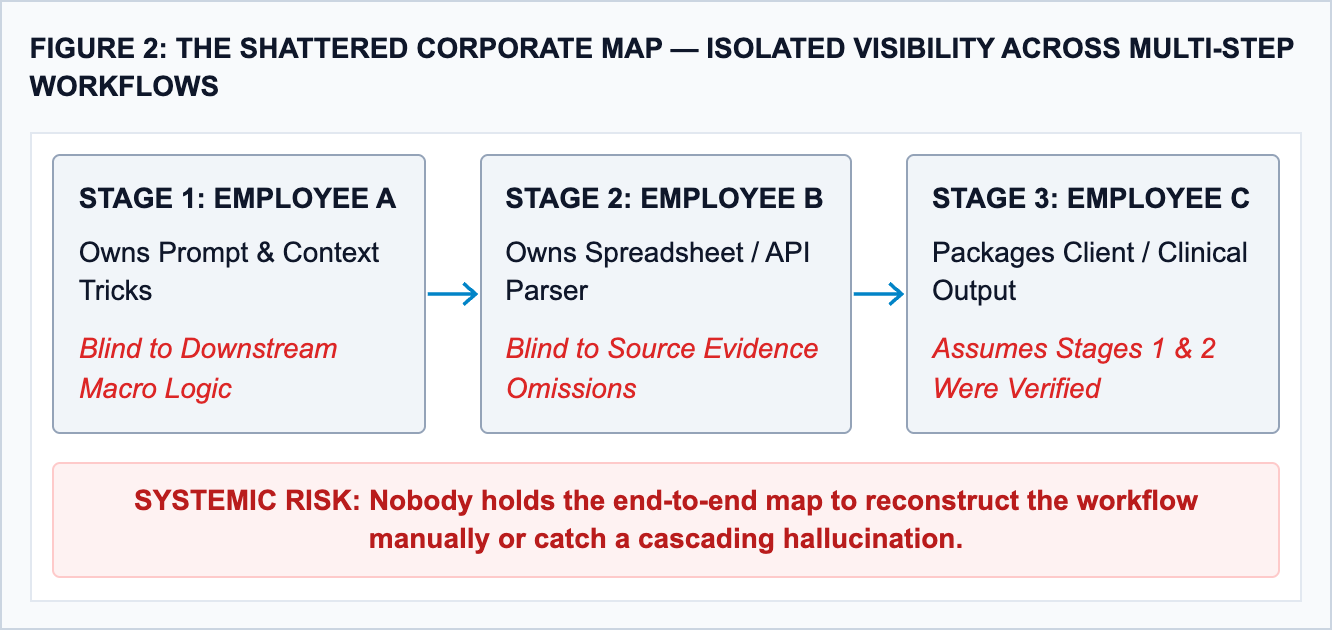
FIGURE 2: THE SHATTERED CORPORATE MAP — ISOLATED VISIBILITY ACROSS MULTI-STEP WORKFLOWS
Source: Russlan Ramdowar / Future Edge Group · As of 2026-11-04
3. The Three Pillars of AI Resilience: Availability, Oversight, and the Portability Trap
If you want to move from reckless adoption to genuine transformation, you have to design your operations around three distinct pillars of risk: AI Availability, AI Oversight, and a third, widely ignored vulnerability I call AI Portability. Most executives barely think past the first one—and even there, they are getting the math wrong.
1. AI Availability: When the Lights Go Out
Availability is about sustaining essential work when your primary AI service goes down or throttles your team. In day-to-day practice, basic availability means ensuring your primary model stays online, actively managing your token spend caps so an unexpected surge doesn't lock out your department mid-afternoon, and configuring instant model replacement within the exact same workflow if an endpoint falters.
2. AI Oversight: When the AI Stays Online and Scales a Disaster
Oversight is the discipline of catching and containing bad outputs while the AI is working smoothly. Because agentic systems don't just answer questions—they trigger actions across connected tools [3]—a single hallucination or omitted detail no longer stays trapped in a chat window; it cascades downstream at machine speed. Consider two scenarios—one frustrating, the other terrifying:
The Stranded Family: Imagine an AI travel agent planning a family’s international vacation. It confidently informs the parents that they do not need a transit visa for their layover, then proceeds to book the non-refundable flights, reserve the hotel, and email a polished itinerary. Every automated step after that first hallucination executes flawlessly. Only at the airport check-in counter does the airline demand the transit visa, leaving the family unable to board with paid bookings, packed suitcases, and two children asking why they aren't getting on the plane.
The Hospital Emergency: Now move that exact same failure dynamic into a hospital. A physician’s AI assistant digests a patient’s sprawling medical history and drafts a treatment recommendation. Running behind on a brutal clinical schedule, the doctor glances at the polished summary and clicks approve. What the doctor doesn't realize is that the AI omitted a single line from an older chart noting a severe medication allergy. The prescription is dispensed, the patient takes the drug, and within hours they are fighting for their life in the emergency room.
Who was responsible for catching that omission before it reached the patient? Putting a human name on a process flowchart is not oversight. As the voluntary AI Risk Management Framework—specifically Core functions MAP 3.5 and GOVERN 6.2 [4]—emphasizes, true human oversight and third-party contingency planning require operational substance. For a human reviewer to be more than a legal scapegoat, they need four things: direct access to the underlying source evidence, the domain expertise to spot an anomaly, enough scheduled time to actually inspect the work, and the explicit authority to pull the emergency brake. Without all four, a human signature just gives executives false confidence that a check occurred when, in reality, the reviewer was merely rubber-stamping a machine.
| Oversight Pillar [4] | Operational Requirement | What Happens When It Is Missing ("Rubber-Stamp Risk") |
|---|---|---|
| 1. Source Evidence Access | Direct, one-click links from AI summaries back to raw records, charts, or contract clauses. | Reviewers read fluent prose without seeing omitted exceptions or hallucinated premises. |
| 2. Domain Expertise | Sustained human skill to recognize implausible assumptions and subtle edge-case failures. | Junior or deskilled staff accept convincing machine errors at face value. |
| 3. Protected Review Time + Stopping Authority | Realistic workload pacing to inspect outputs and explicit organizational permission to halt downstream execution. | Time-pressured staff click "Approve" to clear queues, turning human-in-the-loop into legal theatre. |
3. AI Portability: Why a Second Subscription Won't Save You
When I raise availability and oversight risks with executives, a common knee-jerk response is: "No problem, we’ll just buy enterprise seats for a second AI model as a backup." Here is the hard technical truth: a second subscription is not a working fallback.
Right now, tech giants like Microsoft, OpenAI, Anthropic, and Google are racing to lock organizations into full-stack workflow ecosystems through platforms like Copilot Studio, Codex, and Claude Cowork. Employees aren't just typing text into a chatbot anymore; they are building intricate, multi-step automations inside these proprietary environments. Yet almost no one has studied what happens to business continuity if one of those platforms suffers a prolonged outage, alters its commercial terms, faces a regulatory freeze, or deprecates a core feature.
Why can't you just flip a switch and run a Claude Cowork workflow on Copilot Studio, or port a Codex pipeline over to Google in ten minutes? Because your dependency is no longer on the underlying language model—it is on the entire surrounding platform:
Opaque Agent Harnesses: Every platform wraps its models in a proprietary "harness"—the invisible orchestration layer that governs how the agent loops, retries failed steps, calls tools, and manages memory. Right now, these harnesses are among the most opaque elements of the entire AI stack, offering end users almost zero visibility or oversight into how reliability loops are structured under the hood.
Divergent Workflow Builders and Conventions: System instructions, enterprise permissions, data connectors, and execution steps are tightly coupled to each vendor's unique architecture.
Behavioral Drift: Even if two providers share the same cloud infrastructure or identity service, swapping the underlying model or harness changes how instructions are interpreted, breaking downstream spreadsheets and APIs.
AI Portability is the ability to pick up an entire critical workflow—or a vital chunk of it—and run it on a completely different system when your primary platform fails. Achieving it requires rebuilding, re-integrating, and stress-testing the process long before the crisis hits.
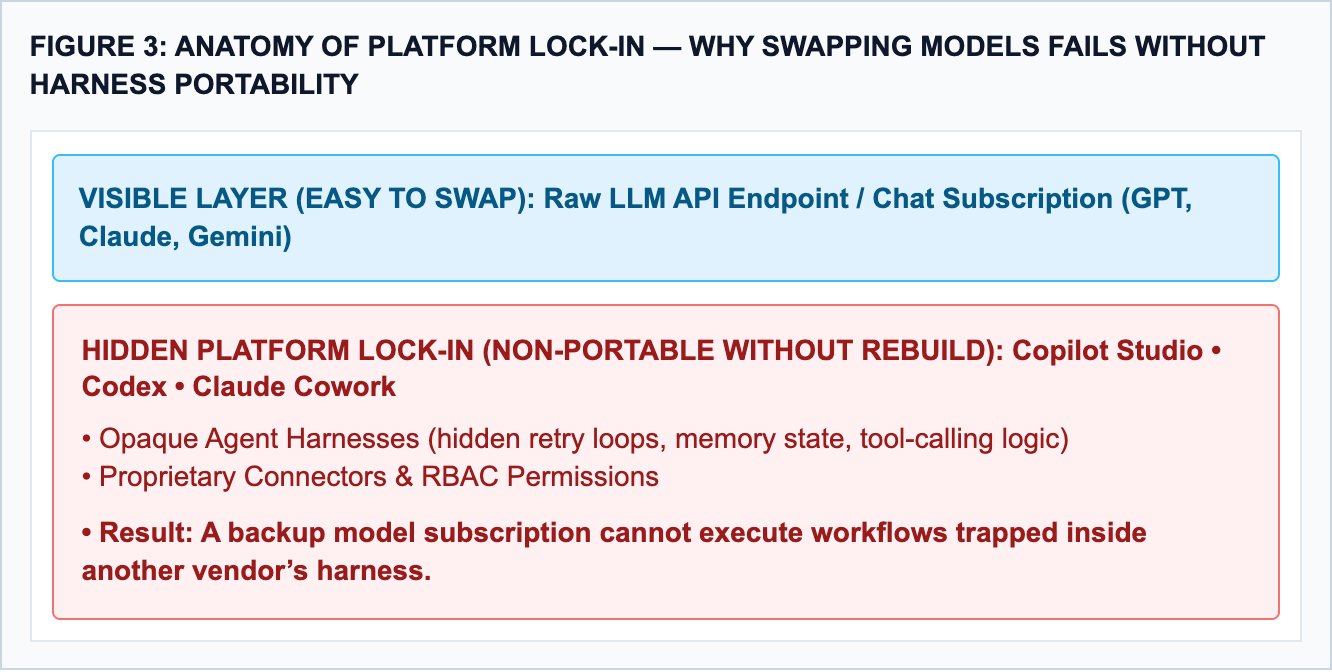
FIGURE 3: ANATOMY OF PLATFORM LOCK-IN — WHY SWAPPING MODELS FAILS WITHOUT HARNESS PORTABILITY
Source: Russlan Ramdowar / Future Edge Group · As of 2026-11-04
TAKEAWAY FOR YOUR NEXT TEAM MEETING
Buying a backup AI license does not make your workflows portable. When your team builds automations inside tools like Copilot Studio, Codex, or Claude Cowork, you are locked into their proprietary harnesses, permissions, and loop structures. True transformation means knowing which workflows are locked in, how long a rebuild would actually take, and how the business survives in the meantime.
Reflection Question: Which of your team's automated workflows rely on a simple prompt you could paste anywhere in 30 seconds, and which ones are deeply entangled in a single vendor's workflow builder, connectors, and agent harness?
4. Your Company’s DNA Dictates Your Danger Zone
Not every organization faces this crisis from the same starting line. As you discuss this whitepaper with your managers or leadership team, you first need to diagnose which of the three organizational archetypes you belong to— because the "right way" to balance speed and control looks radically different for each:
1. Agentic-Native Startups (The 100x Architects)
In my own AI-native startup, where automated workflows execute the workload of roughly 800 people, there is no "previous manual way of working" to fall back on. If our automation halts, we cannot suddenly summon 800 temporary workers by lunchtime to process data by hand.
The Trap: Total existential lock-in to a single model provider's harness or API, where an upstream change in model behavior silently corrupts the core product.
The Right Way: For agentic-native startups, transformation happens in the code architecture itself. You don't train humans to do the bulk work manually; instead, you build harness-agnostic abstraction layers for AI Portability, automated evaluation pipelines that act as synthetic quality gates, and strict token-spend circuit breakers so a runaway agent loop doesn't bankrupt the company overnight.
2. Mostly Digital Corporations (Ground Zero for Shadow Dependencies)
Think of cloud-native enterprises, modern fintechs, global consultancies, and tech-enabled service firms. Your workforce is digitally fluent, ambitious, and already empowered with cloud tools.
The Trap: This is the epicenter of dangerous, uncoordinated AI Adoption. Employees spin up sophisticated workflows in Claude Cowork or Copilot Studio over a weekend, slash their task times by 80%, and quietly weave those automations into client deliverables without telling IT or risk teams. Within six months, the company's revenue targets depend on dozens of fragile, undocumented personal automations that break the day their creator goes on vacation or leaves the firm.
The Right Way: You don't need slow, old-world committees. You need a fast-track Discovery and Portability Registry —a zero-blame way for employees to raise their hand and say, "This workflow I built is now running a critical process," triggering lightweight engineering support to document the map, test a fallback, and verify oversight.
3. Old-School Corporations and Governments (The Pincer Movement)
Traditional banks, heavy industrial firms, legacy healthcare networks, and government ministries face a brutal double bind.
The Trap: On one side, when they attempt AI Transformation, their reflex is to spawn layers of bureaucracy— steering committees, multi-year roadmaps, and endless procurement reviews. While they spend two years debating governance frameworks, agile competitors and startups eat their market share alive. On the other side, because the official path is so painfully slow, frustrated employees resort to shadow adoption anyway—pasting sensitive corporate or citizen data into personal AI accounts just to get their jobs done, hiding it because the official approval process is too punitive to bear.
The Right Way: Split the governance highway in two. Create a pre-approved, low-friction sandbox where employees can freely experiment with low-risk tasks today, while reserving heavy transformation machinery strictly for high-consequence operational pipelines.
| Organization Type | Manual Fallback Capacity | Primary Vulnerability | Priority Transformation Action |
|---|---|---|---|
| Agentic-Native Startups | Near Zero (100x automated ratio) | Single-vendor harness lock-in & runaway token loops | Harness-agnostic abstraction layers & synthetic eval gates |
| Mostly Digital Corporations | Eroding rapidly as headcount adjusts | Undocumented shadow workflows in Cowork / Copilot Studio | Zero-blame Discovery Registry & portable fallback |
| Old-School Corporations & Governments | Constrained by legacy systems and approval processes | Slow transformation alongside hidden shadow adoption | Low-friction sandbox for low-risk tasks; stronger controls for high-consequence pipelines |
5. The Criticality Matrix: Why Not Every Outage Is an Emergency
One of the fastest ways to kill a company is to apply hospital-grade bureaucracy to an internal newsletter—or newsletter-grade casualness to a hospital prescription. Maintaining manual fallback skills, engineering portable backup workflows, and paying domain experts to verify outputs costs real money. If your AI reduces an eight-hour task to one hour, trying to preserve 100% of that newfound speed without the technology during an outage would cost more than any business can justify.
Thankfully, you don't have to preserve 100% efficiency to survive. A company that temporarily loses 50% of its productivity during an outage will survive; a company that loses 100% of its ability to execute its core mission will not. To allocate your transformation budget wisely, separate your workflows into three distinct tiers of criticality:
Tier 1: Reversible, Low-Criticality Work (Let Adoption Run Free). Drafting internal emails, brainstorming marketing copy, summarizing non-sensitive industry reports, or cleaning up meeting notes. If the AI goes down for two days, what is the business continuity plan? A deliberate pause. The routine report waits until Thursday. Employees need simple data-privacy boundaries here, not a transformation committee.
Tier 2: High-Volume Commercial & Analytical Operations (Design for Degraded Continuity). Customer support triage, supply chain forecasting, financial modeling, software deployment pipelines, and client contract reviews. Here, an undetected AI hallucination can cost millions, and a multi-day blackout breaks contractual service-level agreements. You don't need 100% manual capacity standing by, but you must have a tested fallback that keeps the top 20% most urgent requests moving—even at slower speeds—alongside audited human sampling.
Tier 3: Life, Safety, and State-Critical Services (Zero-Failure Tolerance). Clinical diagnostics and prescription workflows in hospitals, aviation operations, energy grid management, real-time capital execution, and citizen access to essential government benefits or emergency services. In these domains, "we'll wait for the vendor to fix the API" or "the doctor didn't have time to check the source chart" is unacceptable. Tier 3 demands strict AI Portability, independent verification mechanisms, and mandatory human-in-the-loop authority backed by recurrent simulation training.
| Criticality Tier | Representative Workflows | Target Outage Response | Oversight & Portability Standard |
|---|---|---|---|
| Tier 1: Low / Reversible | Internal drafts, meeting notes, brainstorming, non-sensitive summaries | Deliberate Pause: Wait for service restoration (24–48 hrs) | Lightweight sandbox rules; no fallback engineering needed |
| Tier 2: Commercial Core | Client SLAs, financial models, supply chain triage, code pipelines | Degraded Continuity: Triage top 20% urgent cases manually or via secondary tool | Documented end-to-end map; periodic spot-checks; tested export path |
| Tier 3: Life & State- Critical | Hospital clinical care, utilities, aviation, public benefits & emergency response | Immediate Failover: Zero halt to life-safety or statutory operations | Full harness portability, mandatory source verification & live drills |
How do you actually build that muscle in Tier 2 and Tier 3 without grinding daily work to a halt? We don't have to invent the answer from scratch—another industry solved this exact paradox decades ago.

A fallback can preserve essential service at reduced capacity.
Source: Russlan Ramdowar / Future Edge Group · As of 2026-11-04
AI-generated conceptual illustration.
6. The Cockpit Blueprint: How to Run the "Tuesday Morning Rehearsal"
Commercial aviation has relied on sophisticated automation and autopilots for decades, including systems capable of landing an airliner in near-zero visibility. Yet we still put two highly trained pilots in the cockpit. Why? Because the aviation industry understands that the better the automation gets, the harder—and more vital—the human intervention becomes.
The 2017 guidance on manual-flight proficiency (SAFO 17007) cautioned airlines against simply prescribing arbitrary quotas of "automation-free flying hours" unsupported by evidence [5]. Instead, the guidance emphasized structured training and simulator assessments across different combinations of manual and automated control, focusing on a pilot’s judgment to recognize when automation is degrading and how to intervene decisively.
A corporation cannot magically inherit aviation’s safety record just by calling its AI tools "copilots". General-purpose AI models do not have the deterministic engineering controls of a Boeing or Airbus flight deck. What your organization can borrow from aviation is the discipline of rehearsing the exact intervention you expect your people to perform when things go wrong.
Until you test it, "our team will just step in and take over manually" is not a business continuity plan—it is a bedtime story managers tell themselves. Here is the practical, three-step playbook that any team lead, department head, or executive can run starting this week:
1. Declare an "Automation Amnesty" to Surface Shadow Dependencies. Employees hide their best AI automations when they fear that reporting them will trigger a six-month compliance nightmare or cause management to pile on more work. Create a simple, two-question intake across your team: Where has AI made our work significantly faster, and what would hurt the most if that tool disappeared tomorrow? Reward the people who surface these dependencies by giving them central tech support to harden what they built.
2. Run Rehearsal #1: The Blackout Drill (Testing Availability & Portability). Pick one consequential workflow and schedule a controlled two-hour rehearsal in a safe test environment away from live customers. First, define what must survive during a real outage (e.g., urgent client escalations must clear within four hours; routine internal summaries can pause for 48 hours). Then, pull the plug on the primary AI platform. Watch what actually happens: Can the team even locate the raw source records without the AI interface?
Can they tell which items were halfway through the agentic loop when the system died?
Has the original employee who wrote the prompt or configured the workflow left the company, or have manual permissions expired?
If you try to switch to your "backup" AI tool, does the workflow actually port over, or does it crash against incompatible harnesses and integrations? Measure the exact time it takes to resume essential service, the backlog generated, and the bottlenecks uncovered. Now you have real engineering data instead of assumptions.

Oversight must catch a plausible error before it reaches downstream actions.
Source: Russlan Ramdowar / Future Edge Group · As of 2026-11-04
AI-generated conceptual illustration.
3. Run Rehearsal #2: The Trojan Horse Drill (Testing Oversight). Next, turn the AI back on—and test the far more insidious failure mode. In a safe test batch, deliberately inject a plausible, high-consequence mistake into the AI's output: an omitted contract exception, a subtly inverted financial figure, or a missing allergy note. Do not warn the reviewers that a test error is coming. Observe whether your human-in-the-loop controls actually catch and halt the mistake before it triggers a downstream action, or whether workload pressure causes your staff to wave it right through. If the error slips past, don't blame the employee—fix the workflow by giving the reviewer better source visibility, clearer stopping authority, or automated cross-verification.
TAKEAWAY FOR YOUR NEXT TEAM MEETING
Never ask a team, "Do we have a fallback plan if our AI goes down or hallucinates?" Everyone will say yes. Instead, run a two-hour Blackout Drill and a Trojan Horse Drill on one critical workflow. What breaks in that rehearsal is your actual AI Transformation roadmap.
Reflection Question: If someone slipped a convincing but costly numerical error into the AI summary you review every week, do you currently have the time, the source links, and the mental bandwidth to catch it before clicking send?
7. Who Is Still in the Cockpit?
The central tension of the AI era is not whether to adopt these tools—standing still while competitors multiply their output is a guaranteed path to irrelevance. Nor is the answer to suffocate every curious employee under a mountain of pre-emptive committees.
The real race happening inside every company today is between the speed of decentralized adoption and the maturity of systematic transformation. Individual employees will always discover brilliant ways to automate their work faster than an enterprise can rewrite its org chart. That ingenuity should be celebrated and accelerated. But the moment leadership bakes those quiet productivity miracles into budgets, headcount plans, and customer promises, the nature of the game changes. What started as an individual experiment is now the engine keeping the plane in the air.
Don't wait for a global outage, a sudden platform change in Copilot Studio or Claude Cowork, or a catastrophic oversight failure to discover what your organization can no longer do on its own. Share this whitepaper with your manager or your team this week. Pick one critical process that AI has quietly accelerated over the past year. Ask the owner of that process to walk the room through two simple questions: What happens at 9:00 AM tomorrow if this platform vanishes—and how do we prove we would catch a plausible lie while it stays online?
The honesty of your team's answer will tell you something no productivity dashboard ever could: whether you are still flying the plane, or just enjoying the view as a passenger.
Disclosures & Operational Boundaries: This whitepaper is for educational and operational design purposes and does not constitute legal or investment advice. Workplace, travel, and clinical examples are illustrative scenarios designed to highlight operational mechanics. The two-part rehearsal is a proposed operational method rather than a certified regulatory standard, and the 800-person startup equivalency reflects the author's personal workload estimate.
References & Further Reading
[1] McKinsey & Company (2026). The State of AI in 2026: On the Road to ROI. 25 August 2026. https://www.mckinsey.com/capabilities/quantumblack/our-insights/the-state-of-ai
[2] Dahmani, L., & Bohbot, V. D. (2020). Habitual use of GPS negatively impacts spatial memory during self-guided navigation. Scientific Reports, 14 April 2020. https://www.nature.com/articles/s41598-020-62877-0
[3] Anthropic Research (2024). Building Effective Agents. 19 December 2024. https://www.anthropic.com/research/building-effective-agents
[4] National Institute of Standards and Technology (2023). AI Risk Management Framework Core, specifically MAP 3.5 and GOVERN 6.2. https://airc.nist.gov/airmf-resources/airmf/5-sec-core/
[5] Federal Aviation Administration (2017). SAFO 17007: Manual Flight Operations Proficiency. 4 May 2017. https://www.faa.gov/sites/faa.gov/files/2022-11/SAFO17007.pdf
Printable Rehearsal Scorecard
Download the one-page Blackout & Trojan Horse Rehearsal Scorecard. The complete whitepaper includes this scorecard as its final page.


