

Same reports. Different final forecast.
Fourteen research reports about Moderna enter a synthesis pipeline. Gemini's five-year forecast is +4.98%; Astra's is -9.98%. The source reports and their forecast paths are unchanged. The difference is how the final AI layer allocates influence. This study asks how much that layer changes the answer, whether source-model labels affect its judgments, and when a weight change matters numerically.
- Fixed source reports
- 98
- Consensus outputs
- 56
- Equity sign reversals
- 2 of 6
- Bitcoin forecast gap
- 29.45 pp
14 per asset across seven selected assets.
Two synthesizers and four conditions.
Five-year baseline forecasts under different synthesizers.
Difference in predicted five-year price return, not realized return.
A side study of the regular iPulse AI pipeline
The completed Batch 7 release covered 426 curated assets, with fourteen source opinions and one consensus per asset: 5,964 reports and 426 consensuses. Each opinion combines an investment framework, a mode and a source model. Twelve reports per asset use Gemini 3.8 Flash; one uses Claude Opus 5 and one GPT-6 Astra. This is a 12:1:1 report panel, not fourteen independent models or three equally represented providers. The parent release records 643.3 million input tokens and 141.2 million generated tokens across 6,816 completed generation stages. Those figures describe workload, not research quality.
The research council has distinct jobs: advisors submit separate reports, a synthesizer assesses the evidence behind each report, and code turns the assigned weights into a forecast path. Equal weighting remains a transparent comparator. Evidence-sensitive synthesis can distinguish a credible contrarian case from repeated weak reasoning, but introduces another model judgment that must itself be audited. This paper does not prove an accuracy advantage over averaging.
What we held fixed—and what we changed
We reused three equities with aligned forecasts (Visa, SAP and IBM), three with divergent forecasts (Nebius, Moderna and Kratos), and one crypto forecast (Bitcoin). The 98 reports and their original forecasts were frozen. Seven original Gemini consensus baselines were reused; 49 additional synthesis requests brought the archive to 56 outputs. Neither the underlying reports nor the production forecasts were regenerated for this comparison.
| Condition | What changes | What the comparison can tell us |
|---|---|---|
| Blinded baseline | Explicit source-model labels withheld | How the two synthesis configurations allocate influence. |
| Blinded repeat | Same prompt and report presentation | A reference for run-to-run variability. |
| Reversed order | Report order and its checklist reversed | Sensitivity to that presentation change. |
| Source models disclosed | True source-model labels supplied | Source-label sensitivity; not a randomized causal test. |
Source: Six equities form the matched treatment panel. Bitcoin's reversal and disclosure requests also changed a checklist, so those two contrasts are qualified separately. Retrieval and execution timing were not identical across providers.
Changing the synthesizer changes the forecast
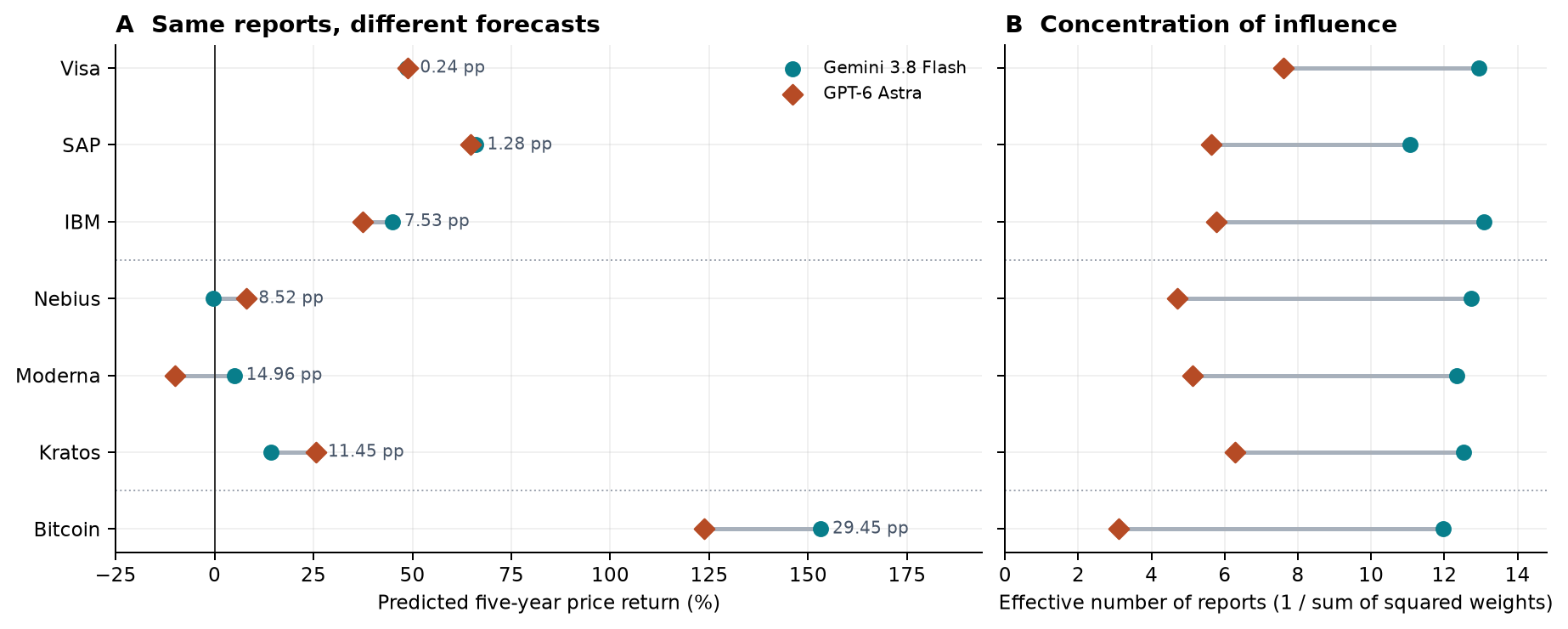
Blinded baselines, original paper Figure 2. Source reports stay fixed; forecasts are model outputs, not realized returns.
Source: Russlan Ramdowar / iPulse AI research · As of 2026-10-01
Unchanged scientific figure from the released v1.0 paper; no new analysis.
| Asset | Gemini synthesis | Astra synthesis | Absolute gap |
|---|---|---|---|
| Visa | +48.68% | +48.92% | 0.24 pp |
| SAP | +65.88% | +64.60% | 1.28 pp |
| IBM | +44.96% | +37.43% | 7.53 pp |
| Nebius | -0.42% | +8.10% | 8.52 pp |
| Moderna | +4.98% | -9.98% | 14.97 pp |
| Kratos | +14.19% | +25.64% | 11.45 pp |
| Bitcoin | +153.15% | +123.70% | 29.45 pp |
Source: Cumulative price-return predictions over 20 quarters, excluding dividends. Gaps use unrounded calculations; displayed predictions are rounded. These are archived model outputs, not achieved investment returns.
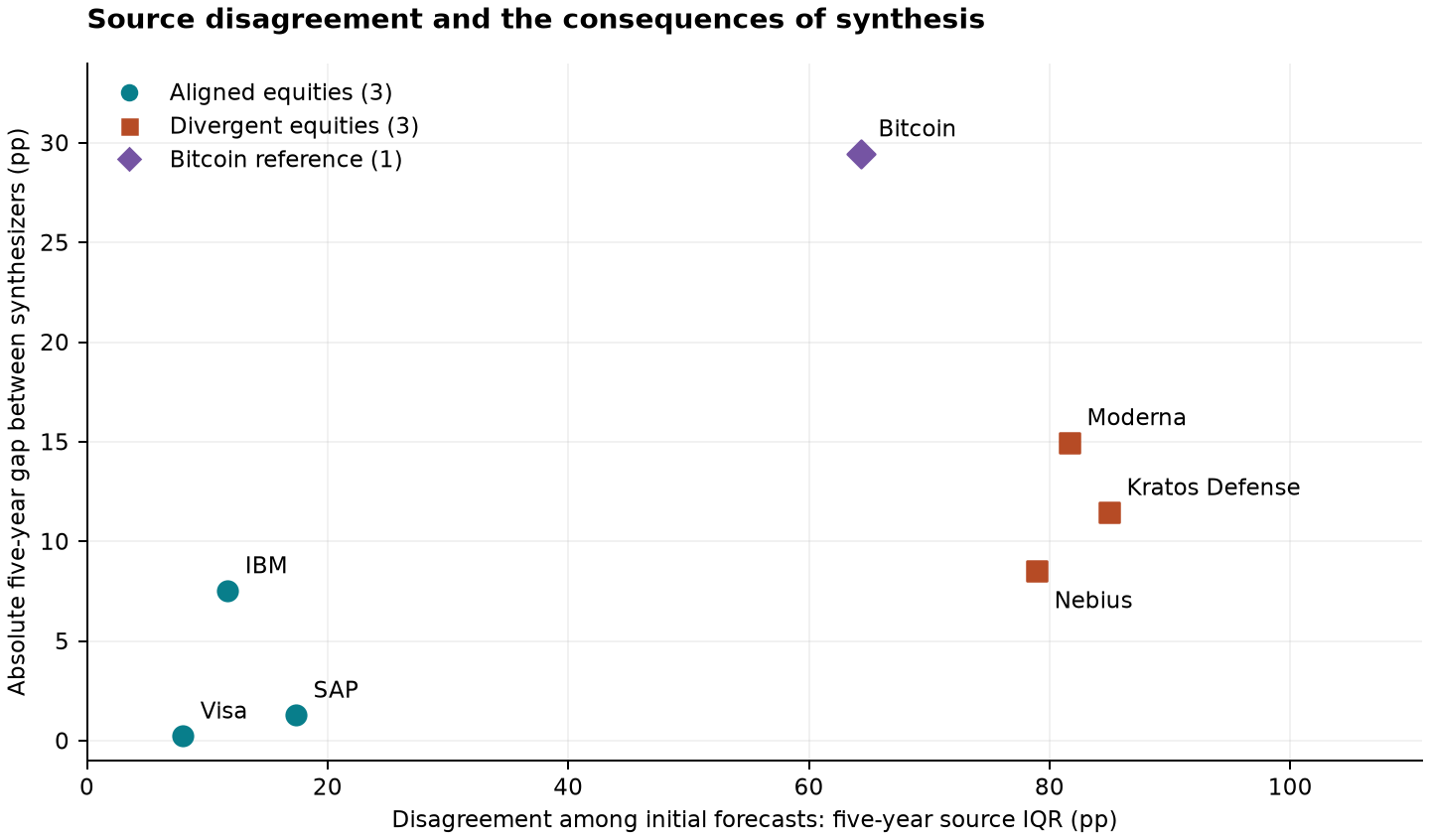
Seven selected cases: source disagreement and the resulting synthesis gap. Descriptive comparison, not a population regression or causal effect.
Source: Russlan Ramdowar / iPulse AI research · As of 2026-10-01
Unchanged scientific figure from the released v1.0 paper; no new analysis.
The mean five-year gap was 3.02 percentage points for the three aligned equities and 11.64 for the divergent equities. The relationship is descriptive: seven selected cases do not establish that dispersion causes model disagreement. Bitcoin had the largest synthesis gap even though all fourteen source reports predicted a positive five-year return. Agreement about direction can coexist with substantial uncertainty about magnitude.
When model names become part of the evidence
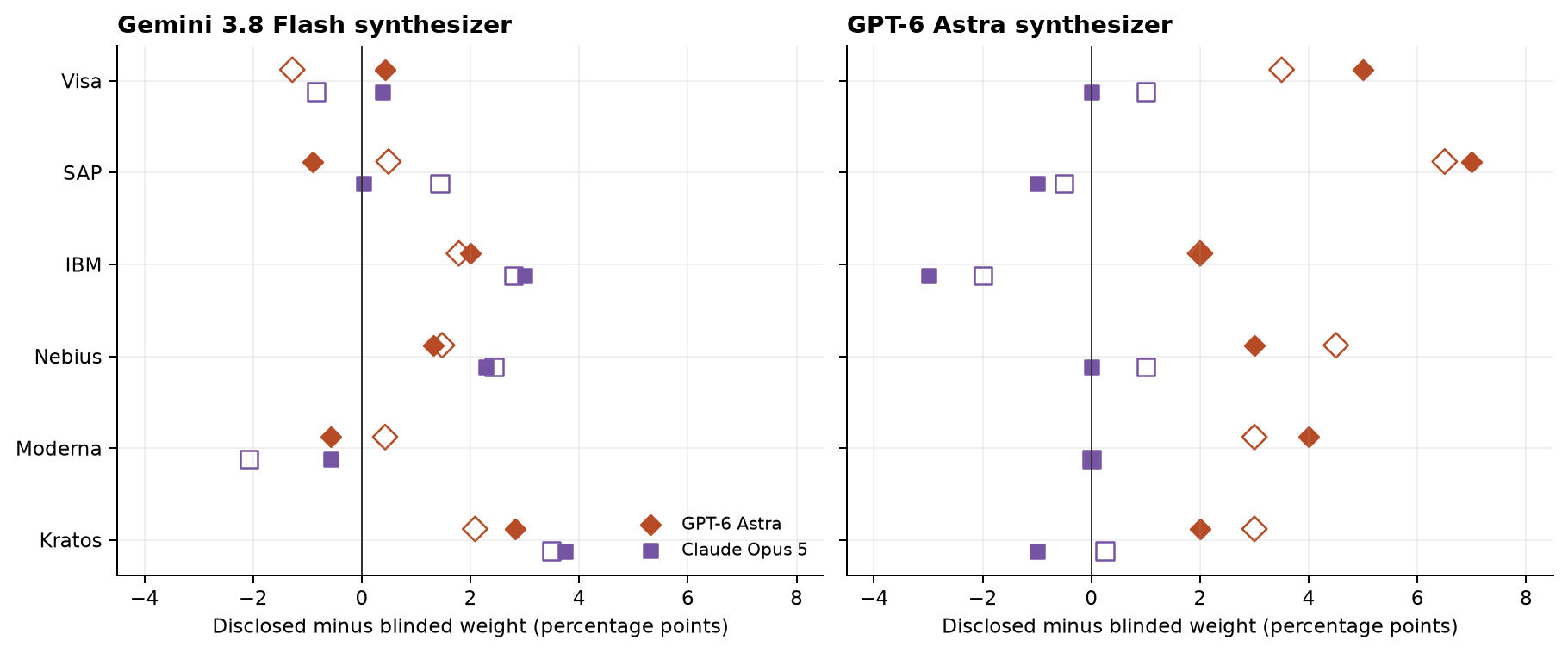
Original paper disclosure comparison. References are the original blinded run and the mean of two blinded runs. Selective own-source uplift does not identify a causal mechanism.
Source: Russlan Ramdowar / iPulse AI research · As of 2026-10-01
Unchanged scientific figure from the released v1.0 paper; no new analysis.
Under Astra synthesis, disclosing source identities increased the Astra report's weight in all six matched equities, by an average of 3.83 percentage points against the original blinded baseline. The increase remained 3.75 points when disclosure was compared with the mean of two blinded runs. The Opus report's corresponding mean change was essentially zero (-0.04 points) against that two-blind reference. The defensible finding is selective own-source uplift in this panel, not a robust penalty against Opus or symmetric favoritism by every model.
This pattern is consistent with source-identity preference, but does not identify its cause. The Astra, Opus and matched Gemini researcher reports share an investment framework and mode; their actual evidence and quality can still differ. External model benchmarks do not establish equal quality for these particular reports. One disclosed realization, variable retrieval and true rather than randomly swapped labels prevent a causal conclusion. Anonymizing source-model identities removes explicit labels, not every stylistic cue.
Repeatability is only one kind of stability
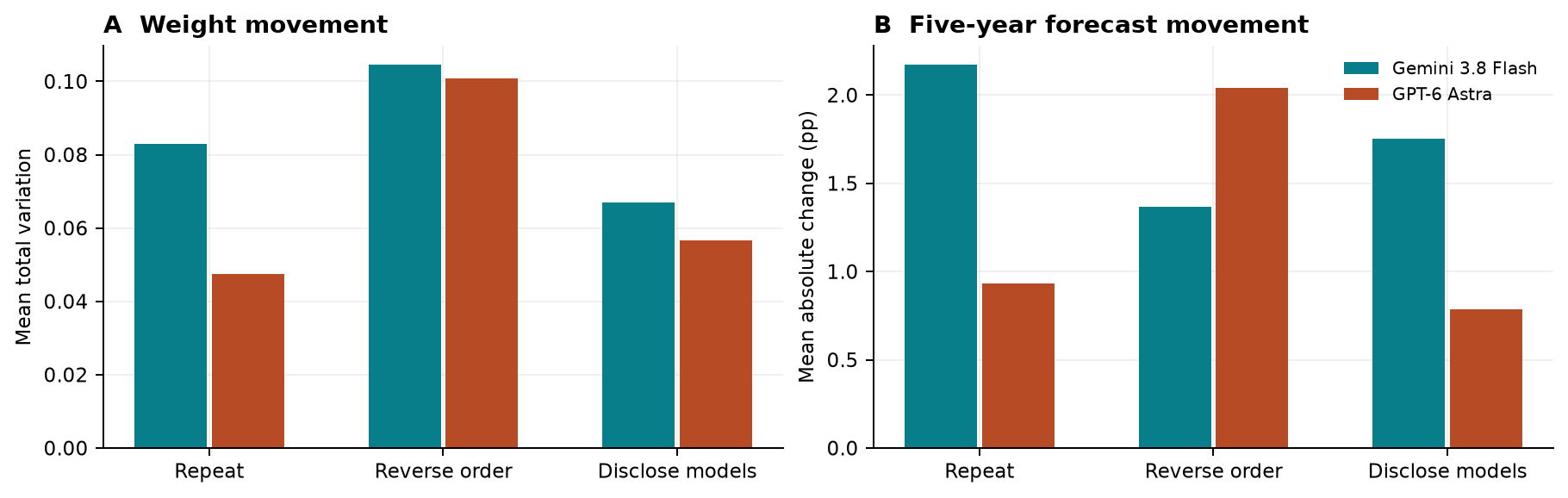
Original paper stability comparison across six selected equities. Repeatability and order sensitivity are distinct; each treatment has only one realization per model and asset.
Source: Russlan Ramdowar / iPulse AI research · As of 2026-10-01
Unchanged scientific figure from the released v1.0 paper; no new analysis.
Across the six equities, Astra moved less than Gemini on an unchanged-prompt repeat: the mean absolute five-year difference was 0.93 versus 2.17 percentage points. Under order reversal, Astra moved more: 2.04 versus 1.37 points. Neither observation defines a universal robustness ranking. Weight stability and forecast stability also differ: Visa's substantially different allocations produced almost identical terminal forecasts, while Bitcoin's common positive direction hid a 29.45-point magnitude gap.
The calculation is part of the model
Batch 7 code normalizes submitted report weights, combines each quarter's frozen return using those weights, then compounds the resulting quarterly series. Averaging completed source price paths is a different operator. Keeping Nebius's Gemini weights fixed, the first method predicted -0.42% over five years; the second predicted +6.95%. No report, weight or language-model judgment changed. A reproducible consensus therefore needs its numerical rule, not just a narrative about the weights.
From Batch 6 lessons to Batch 7 controls
The founder identifies the Batch 6 review as the origin of evidence-sensitive weighting and source-model identity anonymization; both were implemented for Batch 7. The October paper is a later audit using Batch 7 reports. It should not be presented as an experiment conducted on Batch 6 or as evidence that the operating controls were first discovered when the paper was written.
- Weigh evidence, not the number of repeated opinions. Preserve equal weighting as a comparator and require explanations for increased or decreased influence.
- Anonymize explicit source-model identities during weighting, while retaining frameworks, evidence and a separate auditable provenance mapping.
- Test repeats and order changes separately; trace changed weights through the frozen forecasts rather than assuming they have large or small consequences.
- Publish normalization and pooling code. Separate aggregation behavior from forecast accuracy, which requires realized outcomes.
What this study does not establish
- A selected seven-asset case study cannot establish population effects, a general provider ranking or independent evidence from treating every weight as a separate observation.
- Web retrieval and timing differed; the study isolates neither model identity nor every information input. Bitcoin's two treatment contrasts have an additional checklist confound.
- There are only two blinded realizations and one reversal/disclosure realization per synthesizer and asset. The Opus report is a diagnostic outside-family comparator, not a randomized quality-matched control.
- At the manuscript cutoff, no target had matured; the first equity targets are 18 December 2026. No finding establishes predictive superiority, calibration, profit or investment performance.
- Historical chart backgrounds in the full PDF are retrospective context, not a point-in-time model input. Historical-price CSVs are excluded from public downloads.
Paper, data, code and disclosures
The archival release contains the 22-page paper, 98 frozen reports, 56 consensus outputs, 784 allocations, requests and rationales, and offline reproduction code. The original paper and research data use CC BY 4.0; code uses MIT. Third-party material retains its own terms. This website digest does not alter that released version. An arXiv link will be added only when a public identifier is announced.
Russlan Ramdowar is the founder of Future Edge Group FZE, which develops iPulse AI, and has a commercial interest in the platform studied. As disclosed in the paper, AI systems assisted with research operations, coding, audit and manuscript preparation; responsibility remains with the named human author. Provider names identify archived configurations and do not imply endorsement. This is research, not personalized investment advice.


